Noesis


The Journal of the Mega Society


May 2004           Issue 169



Officers


Editor and Publisher:                           Ron Yannone

189 Ash Street #2

Nashua, NH 03060


Administrator:                                     Jeff Ward

13155 Wimberly Square

San Diego, CA 92128


Internet Officer:                                    Kevin Langdon

P.O. Box 795

Berkeley, CA 94701


Founder:                                             Ronald K. Hoeflin

P.O. Box 539

New York, NY 10101


no·e·sisGreek Þ understanding – to perceive.  Psychology Þ the cognitive process


The Mega Society was founded in 1982 and has been documented in the GUINNESS BOOK OF WORLD RECORDS during the 1980s as the most exclusive society.  Mega means million and denotes the one-in-a-million status of its members.   Presently, the only viable adult-level admissions test is the Titan Test, developed by its founder, Ron Hoeflin – where 43/48 correct answers corresponds to the minimum accepted IQ level of 176.  See www.megasociety.net  Since its GUINNESS “distinction” in the 1980’s, the Mega Society with its 99.9999 percentile member status, remains “the most elite ultra-high IQ Society.”

Editorial Introduction to NOESIS Issue #169 – May 2004


In Noesis issue #169, we cover a variety of topics.


First, we have two new non-member subscribers – Fanny K. “Faye” Yannone and Vincent Yannone – both from New Jersey.  Welcome aboard Faye and Vinnie – we look forward to your interesting articles for Noesis!


We start by teaming with Layman E. Allen – a graduate of Princeton with an A.B., Harvard with an M.P.A., and Yale with an LL.B.  Dr. Allen’s research interests are mathematical logic, computers and law, instructional gaming, and artificial intelligence.  He went to Michigan Law School from Yale in 1966.  We open with his original, famous game of modern logic – WFF ‘N PROOF.


Next we include the Mega Society member biography checklist.  Members who have not submitted their biography to the editor, please consider leveraging this outline.


We next present an article on The Lost Art of Letter Writing.  In an era of cell phones and electronic mail (email), this article rekindles the power of the Pony Express.


A chunky part of this issue is provided by an unusual person in the NetherlandsPaul Cooijmans.  Paul devoted about 4 years in developing his Test for Genius – an excellent prospective test for the Mega Society to consider for use as an admissions test.  The Test for Genius is comprised of three parts.  The IQ ceiling is adequate for the Mega Society.  I’d like to propose members review this test and send their comments to the editor as soon as possible.  After comments have been received and issued in a forthcoming issue of Noesis, a vote to use this for admission into the Mega Society will be called.  A nice part of Paul’s test is that the verbal sections are available in French, German, Dutch, and English.  In this issue we include the German language version – for my special friends – Lisa and Otto Rittenbach.  Paul has been extremely generous via his email interchange and has a built-in mechanism to score his Test for Genius fee-of-charge to those who complete his online questionnaire!  I consider Paul one of the “pioneers” in the area of Hi-ceiling IQ testing.


We next team with Russell Ash, author of the famous-selling book for 2004 titled “The TOP TEN of Everything 2004,” by world-class publisher DK (Dorling Kindersley) Limited in Great Britain.  In this section, we extract a variety of Russell’s lists – and transform them into a set of enticing exercises for our readers.  Completed tables, with added insight and information, are provided elsewhere in this issue of Noesis.  We add 3 bonus miscellaneous records questions as well.


By popular demand by our readers, we’ll continue to include articles on FAMOUS QUOTES.  These quotes are presented with blank entries first – to help spark the imagination of our readers – and to increase their appreciation upon learning who the authors are.  The names are presented elsewhere in this issue of Noesis.


Next, we make a few comments on Dr. Ronald K. Hoeflin’s new book, “To Unscrew the Inscrutable: A Theory of the Structure of Philosophy.”  For our new non-member subscribers and readers we include the biography provided in Dr. Hoeflin’s 700-page book.  Dr. Hoeflin mailed in a short biography where he requests articles on psychometrics.  The editor solicits help!  I will try to contribute something in the future – as I learn more about psychometrics.


Next, Administrator Jeff Ward provides the results of the BALLOT for (a) considering Brian Schwartz for membership and (b) the use of the Sigma Society’s SIGMA VI Test for admission into the Mega Society.  On the same page, Mega Society member Chris Cole reports on the number of “visitors” to our Mega Society website.  Please put on your thinking caps when you read the statistics – and get back to the editor with your ideas.


Next, we review how things were 75 years ago from the editor’s perspective – and then Happy Birthday by an anonymous contributor – to a special Mega Society member!


Next, we share a handful of famous short poems – to lighten your reading intensity.  Poetry relaxes the mind.  I invite our readers to submit original poems.


Next, we return to Dr. Layman E. Allen – with his favorite game called Equations – where our readers (young and old) will be challenged – on trying Elementary Problem E1.  NASA rocket scientists were unable to get the complete solution!  The game Equations, regularly played by elementary school students, successfully mitigates absenteeism and markedly improves student’s performance on standard math and IQ tests.  The game Equations develops your mind to reverse-engineer as in the Crime Scene Investigation (CSI) – Las Vegas television series – where the CSI team works backward to analyze and understand the crime.


Next, we take a short detour in commenting on the caliber of the IMO (International Mathematics Olympiad) students.  On the same page, we then test your knowledge on U.S. paper currency in Name That Portrait.”


We next extend hearty congratulations to a Mega Society member for his noteworthy recent technical achievements.


We next share the extraordinary biography of Mega Society member Christopher P. Harding from Australia.  Anyone reading this outstanding biography will be encouraged to push themselves harder in life.  Chris Harding’s volunteer spirit and undying involvement in a plethora of activities will motivate readers of any age!


Mega Society member from Nebraska, Eric Erlandson, requested in the biography he mailed in that readers contribute articles on recreational mathematics.  To initiate satisfying Eric’s request, the editor contacted Joseph Madachy – the author of an excellent book and former editor (and now Editor Emeritus) of the Journal of Recreational Mathematics.  We briefly introduce this journal, its subscription rate, etc.  We hope to include problems in the area of recreational mathematics in the June issue of Noesis.  Readers – please submit your favorite problems!  Because Joe’s first book dates back almost 40 years ago, I assumed Joe was deceased.  I was pleasantly surprised to hear his youthful voice on the phone!


In Noesis issue #168 (April), we presented Albert Frank’s Fourth International Contest of Logical Problems.  Albert (from Belgium) sent a correction – presented in the Prometheus Society journal Gift of Fire, issue 148, May 2004 for the figure used in problem 20.


Next, we team with Mac Anderson – founder of Successories.  In Mac’s new book The Nature of Success, in the chapter titled “Persevere!” we read of a fascinating story given to Mac by his assistant, Marj Webber, titled “Shake It Off And Stand Up.”  Noesis readers, young and old, can learn several valuable lessons from this thrilling story.


Next, for our spiritually-minded readers, the editor shares some simple encouragement for our lives, via Psalm 23.


We end this issue with two copyrighted articles by non-member subscriber Paul Maxim - Transformation of a Text (a literary puzzle) and Mallarmé’s Cigar-Puzzle of 1895.  Paul Maxim exudes enthusiasm for the success of the Mega Society.  His many letters and timely, encouraging voicemail messages are unexpected treats.


NOESIS Journal – May 2004 – Issue #169


CONTENTS

#

TITLE

AUTHOR

PAGE

1

Yale Law School “Training in Logic” Part 1 – “WFF ‘N PROOF”

Dr. Layman E. Allen

5

2

Biography on Layman E. Allen

Dr. Layman E. Allen

8

3

Member Biography Checklist

Officers

9

4

The Lost Art of Letter Writing

Editor

10

5

Biography of Paul Cooijmans - Netherlands

Paul Cooijmans

11

6

Test for Genius – by Paul Cooijmans

Paul Cooijmans

13

7

Test for Genius – Parts I and II in German

Paul Cooijmans

23

8

The TOP TEN Exercises

Russell Ash / Editor

24

9

3 Bonus “Miscellaneous Records” Questions

Russell Ash / Editor

26

10

Encouraging Quotes

Editor

27

11

The TOP TEN Exercises - Answers

Russell Ash / Editor

29

12

Answers to 3 BONUS “Miscellaneous Records” Questions

Russell Ash / Editor

34

13

Dr. Ronald K. Hoeflin’s New Book

Editor

35

14

Dr. Hoeflin’s Biography – as it appears in his new book

Editor

36

15

Ballot Results

Jeff Ward

37

16

Mega Society Website Visitation Statistics

Chris Cole

37

17

Encouraging Quotes - Answers

Editor

38

18

How Were Things 75 Years Ago?

Editor

40

19

Happy Birthday Memories

Anonymous

41

20

Some Poetry Favorites

Editor

43

21

Yale Law School “Training in Logic” Part 2 – “EQUATIONS”

Dr. Layman E. Allen

44

22

Some Odds and Ends – IMO Students

Editor

46

23

Name that Portrait

Editor

46

24

Hearty Congratulations to a Mega Society Member

Editor

47

25

Extraordinary Biography of a Mega Society Member

Chris P. Harding

49

26

Name that Portrait - answers

Editor

61

27

The TARDY BUS Problem - answers

Editor

61

28

Mathematical Recreations

Joe Madachy

62

29

Correction to Problem 20 “Graphic” – 4th Int. Contest of Logical Problems

Albert Frank

63

30

Shake It Off And Step Up

Mac Anderson

64

31

Psalm 23 – for Encouragement

Editor

65

32

Transformation of a Text (a literary puzzle)

Paul Maxim

66

33

Mallarmé’s Cigar-Puzzle of 1895

Paul Maxim

68


Yale Law School “Training in Logic”

Part 1 – “WFF ‘N PROOF”

by Ron Yannone and Dr. Layman E. Allen

(http://www.wff-n-proof.com)

1-800-289-2377


When I was in college, my friend Klaus Rittenbach introduced me to a game his father got him called WFF ‘N PROOF – The Game of Modern Logic by Layman E. Allen.  The original release copyright was 1962.  In the 1969 edition of WFF ‘N PROOF, there are two preface sections – the original and an augmented section. WFF (pronounced ‘woof’) stands for well-formed formula.


WFF ’N PROOF is grounded in the belief that learning ought to be fun – a conviction that allowing youngsters to find joy in learning bears fruit throughout the rest of their lives.  The primary aim of WFF ’N PROOF is to encourage a favorable attitude towards symbol-handling activities in general and, incidentally, to teach something about mathematical logic and provide practice in abstract thinking.


Much of the research in developing WFF ’N PROOF was done on the ALL Project (Accelerated Learning of Logic) at Yale Law School.  The ALL Project was established in 1960 under a grant from the Carnegie Corporation of New York to develop materials for teaching mathematical logic to elementary-school students. [1]


The first two ideas used in playing the WFF ’N PROOF games are the definition of a WFF and the definition of a Proof.  Hence, the choice of WFF ’N PROOF as the name of the games.


The approach to learning of Professors Alan R. Anderson and Omar K. Moore of Yale has served as a guide in designing the WFF ’N PROOF games; learning by doing and a maximum of self-discovery by the learner are emphasized.


Motivation is sustained throughout by seeing to it that the child is not robbed of the opportunity of making a series of interrelated discoveries which lead to the acquisition of some basic intellectual skills. [2]


Although the WFF ’N PROOF games were designed primarily to be fun – to be an autotelic activity that learners would voluntarily spend time doing for its own sake – they were also meant to provide practice in abstract thinking and to teach some mathematical logic.  To the extent that WFF ’N PROOF is autotelic, it will be played merely because it is fun to play – regardless of the fact that something useful is being learned in the process.


If propositional calculus is thought of as a language, then a WFF can be thought of as an expression in this artificial language that is roughly equivalent to a sentence in English prose – the main difference being that in propositional calculus the criteria for what constitutes a well-formed formula are explicit.


Description on the back cover of the box the game comes in – WFF ’N PROOF is a 21-game kit that teaches propositional logic and develops habits of careful reasoning.  The beginning games, which can be played by six-year-olds, teach WFFs (Well-Formed Formulas – expressions that are in mathematical logic similar to what sentences are in English).  The remaining games deal with rules of inference, logical proofs, and the nature of formal systems.  WFF ’N PROOF is entertaining and provides practice in abstract thinking.


The knowledge of logic derived from playing the WFF ’N PROOF games will improve the ability to analyze problems like The TARDY BUS Problem presented below.  Beginners may wish to gain some measure of their own present ability to reason effectively by working through The TARDY BUS Problem.  (WARNING:  Before they have learned to play WFF ’N PROOF, even adults answer most of the questions posed in this problem incorrectly.  The questions are trickier than they at first seem to be.  For good WFF ’N PROOF players, however, such problems are easy.)


Some of the following statements may seem both awkward and reminiscent of a familiar style (especially to lawyer-readers).  If they do, it is for good reason: in syntactic structure they are patterned after statements in the Internal Revenue Code of the United States.  If The TARDY BUS Problem seems complex, its syntax is at least in part responsible.  That is deliberate, of course.  Complicating the syntax is one of the ploys used to construct a problem worthy of your efforts.  The problem would be a great deal simpler, if its syntax were simplified.  (And the same is true of the Internal Revenue Code.)


The TARDY BUS Problem


Given the following three statements as premisses:


1.       If Bill takes the bus, then Bill misses his appointment, if the bus is late.

2.       Bill shouldn’t go home, if (a) Bill misses his appointment, and (b) Bill feels downcast.

3.       If Bill doesn’t get the job, then (a) Bill feels downcast, and (b) Bill should go home.


is it valid to conclude:


Q1 – that if Bill takes the bus, then Bill does get the job, if the bus is late? ___YES___NO

Q2 – that Bill does get the job, if (a) Bill misses his appointment, and (b) Bill should go home? ___YES___NO

Q3 – that if the bus is late, then (a) Bill doesn’t take the bus, or Bill doesn’t miss his appointment, if (b) Bill doesn’t get the job? ___YES___NO

Q4 – that Bill doesn’t take the bus, if (a) the bus is late, and (b) Bill doesn’t get the job? ___YES___NO

Q5 – that if Bill doesn’t miss his appointment, then (a) Bill shouldn’t go home, and (b) Bill doesn’t get the job? ___YES___NO

Q6 – that Bill feels downcast, if (a) the bus is late, or (b) Bill misses his appointment? ___YES___NO

Q7 – that if Bill does get the job, then (a) Bill doesn’t feel downcast, or (b) Bill shouldn’t go home? ___YES___NO

Q8 – that if (a) Bill should go home, and Bill takes the bus, then (b) Bill doesn’t feel downcast, if the bus is late? ___YES___NO


If you answer some of the questions incorrectly, you need practice in logical thinking.

See answers elsewhere in this issue of Noesis.


In Section C of the WFF ’N PROOF user’s manual, pages 160-164, four additional problems are presented.  These should be worked after the player has mastered the WFF ’N PROOF games.  The titles of the four problems, to whet your appetite to purchase WFF ’N PROOF for yourself or someone you really care about, are:


1.      The Logic Problem – with two premises, seven questions

2.      The Relative Ages Problem – with three premises, seven questions

3.      The Cracker Jack Problem – with four premises, fourteen questions

4.      The Politics Problem – with four premises, fourteen questions


[1] L. E. Allen, R. B. S. Brooks, J.W. Dickoff, and P. A. James, The ALL Project (Accelerated Learning of Logic) 69 AMERICAN MATHEMATICAL MONTHLY 497 (1961).


[2] Address by O. K. Moore entitled “The Motivation and Training of Students for Intellectual Pursuits: A New Approach” at the Tenth Thomas Alva Edison Foundation Institute, New York University, November 19, 1959.


Layman E. Allen

 

Text Box: Professor of Law
835 Legal Research
734.764.9339
Fax 734.763.9375
E-mail laymanal@umich.edu


Layman E. Allen has been a pioneer in the use of mathematical logic as a tool of analysis in law as well as in the use of computers in the field of legal research. He has developed a formal system of the logic of legal relations, which includes underlying systems of propositional, predicate, class, deontic, action, time, and capacitive logic. The primary application of the logic of legal relations and its accompanying legal relations language is in the drafting and interpretation of legal documents ranging from constitutions and statutes to contracts and by-laws. In the field of artificial intelligence and law the legal relations language has led to generative expert systems that facilitate analysis of legal provisions having multiple interpretations stemming from ambiguous expression of logical structure. His interest in teaching mathematical logic to lawyers has led to the development of a series of games about logic, mathematics, and law, the most notable being WFF ‘N PROOF, EQUATIONS, and The Legal Argument Game of Legal Relations. Professor Allen is a graduate of Princeton with an A.B., Harvard with an M.P.A., and Yale with an LL.B. His research interests are mathematical logic, computers and law, instructional gaming, and artificial intelligence. He came to Michigan Law School from Yale in 1966.


Publications 2000 -

"The Legal Argument Game of Legal Relations." C. S. Saxon, co-author. J.L. & Info. Science. Forthcoming. (Originally published under the same title in E-Law - Murdoch U. Electronic J.L. 5, no. 3 (1998) at, www.murdoch.edu.au/elaw/issues/v5n3/allen53.html)

"Festschrift: Lee Loevinger." Jurimetrics 40, no. 4 (2000): 394.


Member Biography Checklist

by Mega Society Officers


Editor’s Note:  There weren’t any specific comments on this data sheet.  Those who have responded, sent me their rendition of their biography.  The members who have not submitted their biography to me, please use this as a guide.


        Member’s full name

        Date of information

        Date of birth

        Email address

        Nationality

        Date joined Mega Society

        Sex (male/female)

        Marital status

        Any children (yes/no)

        Name/age/sex of children

        College degree(s)

        Employment history

        Offices held in Mega Society

        Personal goals in life

        Intellectual achievements

        Records achieved in any area

        Sports prowess

        Clubs, associations outside Mega Society and offices held

        Topics in Noesis you would like to see articles on

        Topics in Noesis you would like to contribute

        Offices in Mega Society you would consider

        Musical instrument(s)

        Handedness (left/right)

        Awards won

        Ethnicity

        Position on the left/right political spectrum

        Religion or spiritual practice (if applicable)

        Personal website URL

        Publications

        Business/professional achievements

        Position in family you grew up in (e.g., 3rd of 5 children)

        Products created/released

        Exhibits

        Lectures given

        Political offices sought/held

        Hobbies

        Favorite books, movies, music


The Lost Art of Letter Writing

by Ron Yannone


            When I left home after college in 1976 to work for General Electric Company – Aerospace and Electronic Systems Department (AESD) in Utica, New York, I became very homesick.  I thought I would be the last (of 5 sons) to leave my home in Neptune, New Jersey – and, to date, I have been the only one to leave NJ.  In 1976, I could not afford a telephone, so I resorted to hand-written letter writing.  The price of stamps seemed exorbitant, but my intense desire to be able to share the blow-by-blow events in my life frequently with my parents and brothers, won out.


            Initially, I wrote about once a week.  The letters evolved into the use of Hallmark cards for every conceivable holiday, to homemade stationery, and to the point where I would prowl elegant gift shops within a 50-mile radius for novel cards of the upstate NY region.  The frequency of writing letters increased to several letters weekly.  On occasion, I would go to a nearby pay phone to “audibly connect” with the family – 300 miles away.


            Letter writing remained my hobby.  Practically any event I heard about at work was turned into an opportunity for me to write the person(s) involved in a situation – be it a wedding, a death, a birthday, a promotion, etc.  To say letter writing turned into a missionary activity for me is highly accurate.  Today I remain very fervent in letter writing.  The writing instruments (pens, markers, etc.), the stationery, the stamps used, all play together.  At times I will see a lovely picture in a magazine, cut it out, and tape it to a blank piece of paper, and center my writing around the photo, dovetailing the topic at hand with the photo’s theme.


            Last year, alone, more than 700 letters were written!  The topics for my letters cover all aspects of life – and the “audience” includes people whom I have never met.  But the power-of-the-pen is incredible!  Requests for information, helping people heal from tumultuous events in their lives, simply sending a holiday greeting, thanking someone for help received – all form the bouquet created in the art of letter writing.


            Today, where everyone has a cell phone and email, the manual preparation of a handwritten letter has become nearly obsolete.  To receive a letter in the mail, delivered by Pony Express, is a real thrill for me.  Based on the feedback I receive from people from around the world, handwritten letters and cards are a tremendous, unexpected treat.  Why not take a few moments and write someone special (or not so special) in your life a handwritten letter today!  The therapy you’ll receive in writing handwritten letters is very rewarding.


Biography of Paul Cooijmans

by Ron Yannone
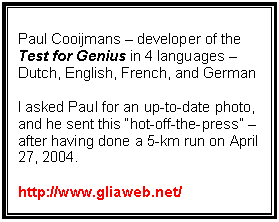


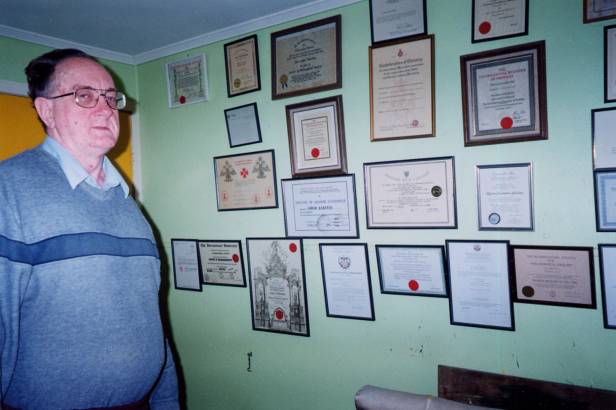
Text Box: Paul Cooijmans – developer of the
Test for Genius in 4 languages – Dutch, English, French, and German

I asked Paul for an up-to-date photo, and he sent this “hot-off-the-press” – after having done a 5-km run on April 27, 2004.

http://www.gliaweb.net/


Name: Paulus Arnoldus Johannes Wilhelmina Cooijmans


Birth: 6 April 1965, Lieshout, Netherlands


Marital status: Single                     Height: 1.78 m                    Weight: 72 kg


Hobbies: Running, recumbent riding


Education: Conservatory, composition and guitar; programming courses; web design

courses


Achievement: Minor composition and literature prizes, founding IQ societies, sheet music and book with short stories published, many performances of my compositions took place in the past, several newspaper interviews, two TV performances as guitarist playing own compositions, creating the world's hardest IQ tests attracting over 1000 testees, introducing to The Netherlands and Europe the concepts high-ceiling IQ tests and higher-IQ society, innovative work in music theory


Experience: Founding rock band, composing songs for and playing guitar in it (1982-1987), playing guitar and bass in jazz ensembles (1986-1989), playing classical guitar (preference for Dowland lute music and Bach), playing contemporary serious music in ensembles (1991-1993), playing own guitar compositions, playing Dowland lute songs with singer (1992-1993), guitar teaching (1990-2000), web design, web programming and site maintenance ( the latter three 2001-present)


Positions held (currently): Administrator of Glia Society (includes editing and publishing journal and web site maintenance; 1997-present) and Giga Society (1996-present)


Positions held (past): Guitar teacher for Basis Muziek Onderwijs, Lieshout (1992-1996)


Publications (mostly self-published): dozens of compositions for various casts up to symphony orchestra (sheet music), prose (short stories), several IQ tests and statistical reports thereon, articles in IQ journals, report on early memories research, treatise on music theory, articles on web sites


Interests (other than already mentioned): objective morality; IQ and race, sex, genetics etcetera; measurement of Elementary Cognitive Tasks; Asperger’s Disorder (which I have)


Main current project: researching measurability and correlates of high intelligence and its relation with genius, creativity, personality and psychiatric disorders. Creating a measurement method using both IQ and personality testing to predict genius in an individual.


PAUL COOIJMANS

PB 44

5737 ZG LIESHOUT

NETHERLANDS


Test for Genius – by Paul Cooijmans

http://www.gliaweb.net/


Paul Cooijmans will always score the Long Test For Genius when people take it (all 3 parts discussed below).  There is no fee, unless the test-taker desires a paper report (rather than just an e-mail report), which is $4.  Instead of a fee Paul asks people to submit a questionnaire form for research purposes before taking his tests. The URL for this questionnaire can be found at http://httpd.chello.nl/~p.cooijmans/essay/rfhrt.html


For people who do not have access to the Internet, and who cannot submit the form, they can receive it by postal mail for $5 (USD).


Paul uses an IQ-scale with a standard deviation of 15, so the Mega Society admissions cutoff level of 99.9999 (1–in-a-million level) is then at 171, which requires a raw score of 108 over the three subtests (that is actually 174).  The nonverbal subtest (part) is weighted by 3.


See the online Registration Form on the next page.  Before you can take Paul’s IQ test, you need to complete his online questionnaire.  There are over 250 items. The Test for Genius was designed in 1995, and the latest revision of the verbal subtests were made in 1999 – so we’re looking at an overall development time of four years.  Hi-IQ societies that accept the Test for Genius results are Glia, Giga, Grail, Sigma Society, Pi Society, Dr. Ron Hoeflin’s Top One Percent Society (TOPS) and his One-in-A-Thousand-Society (OATH), and several others.  The ceiling for the full test registers well over the Mega Society IQ admissions level of 176 – which is good. The test consists of 3 subtests: Association (39 items), Analogies (39) and Space, Time and Hyperspace (28).  Spatial items are weighted by 3 in Total score (G). The scores so far out of 162: # testees: 60; Mean: 64.4; SD: 20.72; Male mean: 65.6; Female mean: 53.5 (6 persons).


The norming report for the Test for Genius can be found on:

http://members.brabant.chello.nl/~p.cooijmans/gliaweb/stats/ltfg_e_s.html


G/IQ

G/IQ

G/IQ

G/IQ

G/IQ

8 108
9-10 109
11-12 110

13 111
14-26 114
27 120
28 121
29-33 122
34 123
35-36 126
37 127
38-42 128
43 129
44 130
45-46 131

47-48 133
49 134

50-53 135
54-56 137
57-58 138
59-61 139
62 141
63-70 142
71 144
72 145
73 146
74-75 147
76-78 148
79-86 153
87 155
88-89 163
90-94 164
95-98 165
99-101 166

102-107 168
108 174
109-110 175
111 176
112-113 177
114 178
115-116 179
117 180
118-119 181
120 182
121-122 183
123 184
124-125 185
126 186
127-128 187
129 188
130-131 189

132 190
133-134 191
135 192
136-137 193
138 194
139-140 195
141 196
142-143 197
144 198
145-146 199
147 200
148-149 201
150 202
151-152 203
153 204
154-155 205
156 206

157-158 207
159 208
160-161 209
162 210


(1) Subtests: Association (39 items), Analogies (39) and Space, Time and Hyperspace (28).

(2) No time limit.

(3) Use of reference books is allowed. Discussions with others are not, either before, during or after test-taking. Publication of answers results in prosecution.

(4) Write, type, print or draw your answers on paper, with name, address, age and sex. If you have any, mention scores on prior IQ and aptitude tests, including names of the tests. Mail to this address.

(5) Score report follows.

(6) Enclose the fee mentioned here with your solutions.

(7) Some item numbers are missing as those items have been removed in the latest revision while the numbering is retained.

(8) Nonverbal items are weighted by 3, so maximum raw score is 162.

(9) For a French, German or Dutch version of this test go to Tests.


PART I – Association

The words in each problem have something to do with each other.  There is a common association. The solution isn't necessarily one word but may also be an explanation.  When in doubt, it is allowed to give two answers.  Examples:

ROOF WINDOW DOOR (house) STROKE PURR (cat)

1 TICK STRIKE TIME
2 ATTRACT IRON
3 PARROT ECHO
4 FIRE BASKET FLIGHT
5 BORROW READ
6 FOOD LIQUID SPOON
7 SWIM PRECIOUS METAL BOWL
8 ON IN UNDER OF
9 PUMP DEAR
10 LEGS TOP
11 KITE KEY
12 SPOTS FUSION
13 TUNE TENT
14 CONFETTI ULCER STAMP
15 SNAKE THIGH ORDER
16 ECHOLOCATION BLOOD
17 HANNIBAL KEYBOARD
18 FIELD ANIMAL POLE
19 PERMUTATION LETTERS
20 BEE LIGHT
21 ORACLE BONE STEEL ARGUMENT
22 V J LL BL CK D TH T X M LK W F Z P Q Z
23 NOBEL BLOW SILICIC
24 CHIRALITY SURFACE DOUBLE LOOK
25 COLORBLIND OUTLAW
27 GRAFITTI PARRALAX
28 TEST BEAR LENS
29 AM READ THINK
30 ENIGMA XXL
31 HEEL DAGGER
32 DARK HEAVY
33 POISON BUMP ACRANIA
34 AGAIN APPARENT
35 A MATH IS A GRAN SIN
36 RABBIT SHEEP CAT GOAT Turkey
37 MOULD FIRST
38 MIDWIFE DOCKER
39 CATCH OMISSION
40 COLON SPOOM SALAMI MASCULIN SLIP SANA LOCO IMPALA MOJO

PART II – Analogies


HIGH is to LOW as ALWAYS is to NEVER
STALAGMITE : STAND :: STALACTITE : HANG
CONFIRM : DENY :: JA : ?

1 YEAR : QUARTER :: 12 : ?
2 TOMCAT : TOMBOY :: MALE : ?
3 HIP : TWO :: HURRAH : ?
4 VERTICAL : DIAGONAL :: ELEVATOR : ?
5 THIMBLE : TOE :: WRISTWATCH : ?
6 CAT'S BOX : TOILET :: TOMCAT : ?
7 FUEL INJECTOR : ENEMA SYRINGE :: CYLINDER : ?
9 RADIO : HEAR :: TELEVISION : ?
10 CROSS-REFERENCE : X :: ZELFREFERENTIE : ?
11 KRUISREFERENTIE : SELF-REFERENCE :: DIX : ?
12 GUARD : SING :: EUNUCH : ?
13 LIVING MAN : DEAD ANIMAL :: DERMATOLOGIST : ?
14 VELOCITY : DISTANCE :: POWER : ?
15 CHILD : GLUE :: BEAT : ?
16 OCIP : OTTA :: ONAN : ?
17 ROYAL FLUSH : BLACKJACK :: POKER : ?
18 RUST : BURN :: BURN : ?
19 PRISONERS : JAIL :: SYNONYMS AND ANTONYMS : ?
20 BIKILA : EINSTEIN :: SHOES : ?
21 BEATLES : STONES :: ANIMAL : ?
22 ALL : MANY :: HOMOLOGY : ?
23 LIMERICK : HAIKU :: 1444.478261 : ?
24 ICE : SUGAR :: WATER : ?
25 ALCHEMY : ARCHEOLOGY :: PHILOSOPHER'S : ?
26 PARTLY PEELED EGG : CAVIAR :: DUMDUM : ?
27 3 : 1 :: DENTURE : ?
29 ZIMBABWE : RHODESIANITY :: CEYLON : ?
30 RECTANGLE : ELLIPSOID :: CUBE : ?
31 DEAR : GENIUS :: GENIALITY : ?
32 THE HEAD : THE HEAVENS :: ATLAS : ?
33 MOZART : MAÇON :: SATIE : ?
34 BURGLE : HOMELESS :: TREPAN : ?
35 COLT BIN NILL : SHOE RUB EGG :: SHOE RUB EGG : ?
37 TRANSSEXUAL : SUICIDAL :: HETEROSEXUAL : ?
38 RUE : NAOMY :: PUNICA : ?
40 SANITY : SUPERIOR :: NORMAL : ?
41 VERSA : ARCANUM :: UR GERM : ?
42 ALARM : VORSEN :: C YON AURUM : ?
43 ARISE PURER : O :: MARTYR : ?


Space, Time and Hyperspace

© Paul Cooijmans 1995 - Revision 2004


This test contains 28 problems and has no time limit. Use of reference aids is allowed. Consulting others is not allowed – before, during or after taking the test. Publication of answers will result in prosecution. Draw your solutions on paper or in an electronic document with name, address, age and sex. Mention scores on prior taken IQ and aptitude tests, including the names of the tests.


Answers with the fee mentioned here to Paul Cooijmans

Draw solutions with as much precision as needed to eliminate doubt. Example ( ":" = "is to", "::" = "as" ) :


1.


2.


3.


4.


5.


6.


7.


8.


9.

10.


11.


12.


13.


14.


15.


16.


17.


18.


19.

20.


21.


22.


23.


24.


25.


26.


27.


28. Through a wormhole in the time-space continuum your score will leak onto this test.


PART 1 – Association [GERMAN]


The words in a problem have something to do with each other. There is a common association. The answer need not be one word but may also be an explanation. It is allowed to give two answers.

1 schwimmen Edelmetall Glas
2 Wespentaille Walfisch
3 Biene Licht
4 rund abnehmen zunehmen
5 Drachen Schlüssel
6 Hannibal Klavier
7 Absatz Dolch
8 Grafitti Parralaxe
9 Kaninchen Schaf Katze Ziege die Türkei
10 farbenblind vogelfrei
11 Colon Spoom Salami masculin Slip sana loco Impala Mojo


PART II – Analogies [GERMAN]

12 Fingerhut :(verhält sich zu) Zehe ::(wie) Armbanduhr : ?
13 Auto : laufen :: Boot : ?
14 vertikal : diagonal :: Fahrstuhl : ?
15 gucken : Fenster :: laufen : ?
16 Beatles : Stones :: tierisch : ?
17 3 : 1 :: künstliches Gebiß : ?
18 Bikila : Einstein :: Schuhe : ?
19 Eis : Zucker :: Wasser : ?
20 Spiritus : Leim :: trinken : ?
21 4 : 2 :: wie : ?
22 Wesen : Contradictio :: Schein : ?
23 Limerick : Haiku :: 1444.478261 : ?
24 sanity : superior :: normal : ?
25 versa : arcanum :: ur germ : ?
26 alarm : vorsen :: c yon aurum : ?
27 arise purer : o :: martyr : ?


The TOP TEN Exercises

by Ron Yannone and Russell Ash


In this section we team with Russell Ash, author of the famous-selling book for 2004 titled “The TOP TEN of Everything 2004,” by world-class publisher DK (Dorling Kindersley) Limited in Great Britain, 80 Strand, London, WC2R 0RL.  Russell supported me wholeheartedly to develop a set of matching question exercises from several of the lists in his book.  We hope you’ll sharpen your pencils and write down the answers quickly to the exercises that follow.  The references with dates are given for certain sets, so the reader will have a basis for how/when specific lists were constructed.  Russell Ash welcomes readers to contact him if they disagree on any data presented at ash@pavilion.co.uk  because Russell is presently working on next year’s edition – “The TOP TEN of Everything 2005,”so any feedback, now, is welcomed.


TOP TEN Countries with the Most Neighbors (adjacent countries) [1]

1


6


2


7


3


8


4


9


5


10


[1] It should be noted that some countries have more than one discontinuous border with the same country; this has been counted only once.


TOP TEN Female First Names in the United States [2]

1


6


2


7


3


8


4


9


5


10


 [2] Source: US Census Bureau.  The Top 10 female names according to an analysis of the 1990 US Census account for 10.703 percent of all names.  It should be noted that this list represents names of people of all age groups enumerated, and not the current popularity of first names.  When name data from the Census 2000 are made available, it will reveal the extent to which these traditional names have become diluted by the more fashionable and volatile names of the modern era.


TOP TEN Countries that Spend the most on Health Care [3]

1


6


2


7


3


8


4


9


5


10


[3] Source: World Bank, World Development Indicators 2002.  An annual average of $12 per capita is estimated to provide minimal health services, but many poor countries fall short of this figure.  Ethiopia, for example, spends only $4 per capita on health care.


The TOP TEN Exercises – continued

by Ron Yannone and Russell Ash


TOP TEN Healthiest Countries [4]

1


6


2


7


3


8


4


9


5


10


 [4] Source: World Health Organization, World Health Report 2002


TOP TEN Countries Spending the most on Education [5]

1


6


2


7


3


8


4


9


5


10


[5] Source: UNESCO


TOP TEN Most Common Causes of Unnatural Death in the USA [6]

1


6


2


7


3


8


4


9


5


10


[6] Source: National Center for Injury Prevention and Control


TOP TEN Countries with the Fastest-Growing Economies [7]

1


6


2


7


3


8


4


9


5


10


[7] Source: United Nations, Human Development Report 2002


TOP TEN First Presidential Libraries in the USA [8]

1


6


2


7


3


8


4


9


5


10


The TOP TEN Exercises – continued

by Ron Yannone and Russell Ash


TOP TEN Fastest Rail Journeys in the World – each country [9], [9.1]

1


6


2


7


3


8


4


9


5


10


[9] Fastest journey for each country; all those in the top 10 have other similarly or equally fast services.

[9.1] Source: Railway Gazette International


TOP TEN USA States with the Most Billionaires [10]

1


6


2


7


3


8


4


9


5


10


[10] Source: Forbes magazine, 400 Richest Americans by State, August, 16, 2002


“Miscellaneous Records” – BONUS Questions


B1 – What, in your estimation, is the most grueling physical endurance contest?


B2 – What is the tallest hotel in the world?


B3 – What is the most expensive painting, by whom, and how much?


Encouraging Quotes

by Ron Yannone


By popular demand from our avid Noesis issue #168 (April) readers, we created this new section of interesting quotes from famous people.  People appreciate the opportunity to jiggle their minds a little first, so we leave the author’s name out.  Answers are found elsewhere in this issue.


“The long journey toward the end of the chapter begins with a short step into that first paragraph. ¨ It is in identifying yourself with the hopes, dreams, fears and longings of others that you may understand them and help them.”  ______________


“Experience is the name that everyone gives to his mistakes.” ______________


“Listening is the shortest distance between two people.” ______________


“What sculpture is to a block of marble, education is to a human soul.” ______________


“The right angle to solve a difficult problem is the “try-angle.” ______________


“An error of opinion may be tolerated where reason is left free to combat it.” ______________


“Thinking is the hardest work there is.” ______________


“A wise man’s heart guides his mouth, and his lips promote instruction.” ______________


“There is one thing stronger than all the armies in the world, and that is an idea whose time has come.” ______________


“Intelligence defies fate.  So long as a man can think, he is free.” ______________


“If a man empties his purse into his head, no man can take it from him.  An investment in knowledge always pays the best interest.” ______________


“Better three hours too soon than a minute too late.” ______________


“A child miseducated is a child lost.” ______________


“Natural abilities are like natural plants; they need pruning by study.” ______________


“It was my teacher’s genius, her quick sympathy, her loving tact which made the first years of my education so beautiful.” ______________


“Education is the best provision for old age.” ______________


“Intelligence plus character – that is the goal of true education.” ______________


“Genius is one percent inspiration and ninety-nine percent perspiration.” ______________


“It is the supreme art of the teacher to awaken joy in creative expression and knowledge.” ______


“Tact is, after all, a kind of mind-reading.” ______________


“Those having torches will pass them on to others.” ______________


“Education is not a preparation for life; education is life itself.” ______________


“There are tones of voice that mean more than words.” ______________


“Have a heart that never hardens, and a temper that never fires, and a touch that never hurts.” ______________


“Iron rusts from disuse, stagnant water loses its purity, and in cold weather becomes frozen; even so does inaction sap the vigors of the mind.” ______________


“Upon the subject of education, not presuming to dictate any plan or system respecting it, I can only say that I view it as the most important subject which we, as a people, can be engaged in.” ______________


“The word impossible is not in my dictionary.” ______________


The TOP TEN Exercises - Answers

by Ron Yannone and Russell Ash


TOP TEN Countries with the Most Neighbors (adjacent countries) [1]

1

China (15) – Afghanistan, Bhutan, India, Kazakhstan, Kyrgyzstan, Laos, Macau, Mongolia, Myanmar, Nepal, North Korea, Pakistan, Russia, Tajikistan, Vietnam

2

Russia (14) – Azerbaijan, Belarus, China, Estonia, Finland, Georgia, Kazakhstan, Latvia, Lithuania, Mongolia, North Korea, Norway, Poland, Ukraine

3

Brazil (10) – Argentina, Bolivia, Colombia, French Guiana, Guyana, Paraguay, Peru, Suriname, Uruguay, Venezuela

4

Dem. Rep. of Congo (9) – Angola, Burundi, Central African Republic, Congo, Rwanda, Sudan, Tanzania, Uganda, Zambia

5

Germany (9) – Austria, Belgium, Czech Republic, Denmark, France, Luxembourg, Netherlands, Poland, Switzerland

6

Sudan (9) – Central African Republic, Chad, Dem. Rep. of Congo, Egypt, Eritrea, Ethiopia, Kenya, Libya, Uganda

7

Austria (8)Czech Republic, Germany, Hungary, Italy, Liechtenstein, Slovakia, Slovenia, Switzerland

8

France (8) – Andorra, Belgium, Germany, Italy, Luxembourg, Monaco, Spain, Switzerland

9

Turkey (8)Armenia, Azerbaijan, Bulgaria, Georgia, Greece, Iran, Iraq, Syria

10

Mali (7)Algeria, Burkina Faso, Cote d’Ivoire, Guinea, Mauritania, Niger, Senegal

[1] It should be noted that some countries have more than one discontinuous border with the same country; this has been counted only once.


TOP TEN Female First Names in the United States [2]


NAME

Percent of all First Names

1

Mary

2.629

2

Patricia

1.073

3

Linda

1.035

4

Barbara

0.980

5

Elizabeth

0.937

6

Jennifer

0.932

7

Maria

0.828

8

Susan

0.794

9

Margaret

0.768

10

Dorothy

0.727

[2] Source: US Census Bureau.  The Top 10 female names according to an analysis of the 1990 US Census account for 10.703 percent of all names.  It should be noted that this list represents names of people of all age groups enumerated, and not the current popularity of first names.  When name data from the Census 2000 are made available, it will reveal the extent to which these traditional names have become diluted by the more fashionable and volatile names of the modern era.


The TOP TEN Exercises – Answers - continued

by Ron Yannone and Russell Ash


TOP TEN Countries that Spend the most on Health Care [3]


Country

Health Spending Per Capita (1995-1999) US$

1

US

4,271

2

Switzerland

3,857

3

Norway

3,182

4

Denmark

2,785

5

Germany

2,697

6

France

2,288

7

Japan

2,243

8

Netherlands

2,173

9

Sweden

2,145

10

Belgium

2,137

[3] Source: World Bank, World Development Indicators 2002.  An annual average of $12 per capita is estimated to provide minimal health services, but many poor countries fall short of this figure.  Ethiopia, for example, spends only $4 per capita on health care.


TOP TEN Healthiest Countries [4]


Country

Healthy Life Expectancy at Birth [4.1]

1

Japan

73.6

2

Switzerland

72.8

3

San Marino

72.2

4

Sweden

71.8

5

Australia

71.6

6

France

71.3

7

Monaco

71.3

8

Iceland

71.2

9

Austria

71.0

10

Italy

71.0


USA

67.6

[4] Source: World Health Organization, World Health Report 2002

[4.1] Average number of years expected to be spent in good health


The TOP TEN Exercises – Answers - continued

by Ron Yannone and Russell Ash


TOP TEN Countries Spending the most on Education [5]


Country

Public Expenditure as Percentage of GNP [5.1] (1999/2000)

1

Zimbabwe

11.05