NoesisThe Journal of the Mega Society Issue #176 February 2005 |

Contents
About the Mega Society/Copyright Notice |
|
2 |
Editorial |
Kevin Langdon |
3 |
Some Thoughts from Glenn Morrison |
|
4 |
How Many Quarters? Bayesian Reasoning V |
Chris Cole |
6 |
Rockdale |
Kevin Langdon |
9 |
The First Wearable Computer |
Edward O. Thorp |
12 |
Technically Advanced Ancient Civilizations? |
Chris Cole |
20 |
About the Author, Part I |
Ronald K. Hoeflin |
22 |
Valentine’s Moment |
Richard May |
29 |
Proposed Constitutional Amendment |
Kevin Langdon |
30 |
The Mega Society was founded by Dr. Ronald K. Hoeflin in 1982. The 606 Society (6 in 106), founded by Christopher Harding, was incorporated into the new society and those with IQ scores on the Langdon Adult Intelligence Test (LAIT) of 173 or more were also invited to join. (The LAIT qualifying score was subsequently raised to 175; official scoring of the LAIT terminated at the end of 1993, after the test was compromised). A number of different tests were accepted by 606 and during the first few years of Mega’s existence. Later, the LAIT and Dr. Hoeflin’s Mega Test became the sole official entrance tests, by vote of the membership. Later, Dr. Hoeflin's Titan Test was added. (The Mega was also compromised, so scores after 1994 are currently not accepted; the Mega and Titan cutoff is now 43—but either the LAIT cutoff or the cutoff on Dr. Hoeflin’s tests will need to be changed, as they are not equivalent.)
Mega publishes this irregularly-timed journal. The society also has a (low-traffic) members-only e-mail list. Mega members, please contact the Editor to be added to the list.
For more background on Mega, please refer to Darryl Miyaguchi’s “A Short (and Bloody) History of the High-IQ Societies,”
http://www.eskimo.com/~miyaguch/history.html
and the official Mega Society page,
https://www.megasociety.org/
Noesis, the journal of the Mega Society, #176, February 2005.
Noesis is
the journal of the Mega Society, an organization whose members are selected by
means of high-range intelligence tests. Jeff Ward,
Dues for members of the Mega Society and subscriptions to Noesis for non-members are currently two U.S. dollars per issue (but we are considering elimination of dues). One free issue for each issue containing your work as long as dues are charged. Your expiration issue number appears on your mailing label. Remittance and correspondence regarding dues and subscriptions should be sent to the Aministrator, not to the Editor.
Opinions expressed in these pages are those of individuals, not of Noesis or the Mega Society.
Copyright © 2005 by the Mega Society. All rights reserved. Copyright for each individual contribution is retained by the author unless otherwise indicated.
EditorialKevin Langdon
Ron Yannone has resigned as Editor and Publisher of Noesis. Thank you, Ron, for your service to the Mega Society. As the only candidate for Administrator to respond to the call for candidates for society office was Jeff Ward, the only candidate for Internet Officer was Chris Cole, and the only candidate for Editor was Kevin Langdon, we are all, according to the Mega Constitution, automatically elected.
As none of us really has the time to deal with producing and mailing hard-copy issues, it has been proposed that Noesis become a Web-only publication and that we eliminate membership dues (see the proposed Constitutional amendment contained in this issue). What is proposed is that issues be both e-mailed to those who wish to have them available on their own computers and displayed on our website (this is the same way that Ron's last few issues have been handled). We’ll take a vote after members have had a chance to discuss the proposed changes.
If we don’t have a current e-mail address for you, please write to one of the Mega officers to let us know where we can reach you if we change over to Internet-only publication. We’d also like to try to reach our lapsed members. If you’re in touch with Mega members who aren’t currently participating in society affairs please let us know.
This issue and the next one will be produced in hard copy by me, with the cost of these issues generously underwritten by Chris Cole. Thank you, Chris.
There are about five people who are paid up for more hard-copy issues than would be published under this proposal, and that will have to be taken into account also. We'll need to refund some unearned dues/subscription money to these people if the proposal passes, and find a way of funding the refunds
So far, only Ron Hoeflin’s website and mine are listed on the society’s home page. Please consider adding yours. Write to Internet Officer Chris Cole <chris@questrel.com>.
As usual, we need interesting and thought-provoking material for publication in Noesis. Please write something, respond to something in this issue or previous issues, or look for something suitable for publication in your files.
The deadline for #177 is April 1.
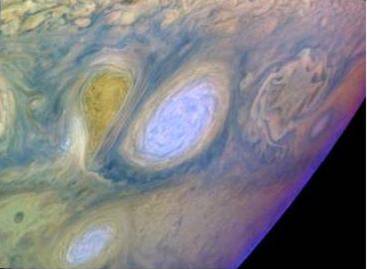
Cover: Jupiter from Galileo (NASA)
Back Cover: An image generated with “Whorlflower,” a routine in Hallucinations™, by Kevin Langdon
Some Thoughts from Glenn Morrison
Below is a shot of the electric vehicle I recently designed and built using off-the-shelf parts found on the internet. It has a 35-mile range on 0.56 kwh lead-acid battery storage, 19 mph max speed. The thing on the top is a 100 watt tiltable solar panel made from photovoltaic cells cemented onto rigid foam type house insulation.
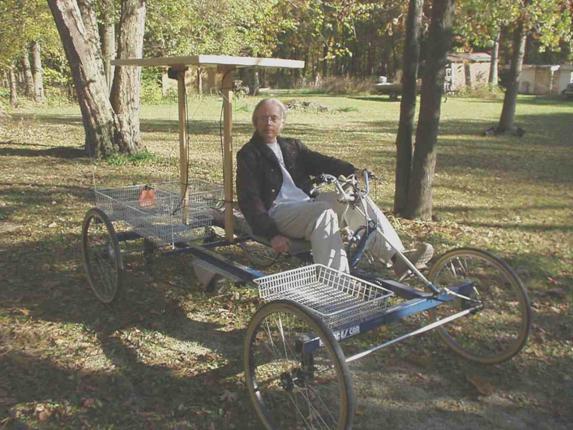
I started designing it in July 03, and finished the basic vehicle to the point of usability in Jan 04. By June 04 I’d installed the solar panel. Over that period I probably spent 30 hours actual “tool time,” 30 in front of the computer, and 100 just idly thinking about it. Total cost came to approx $3900.
It serves as cheap practical neighborhood transport and at the same time as a concept test platform for further development.
Early in the design stage I checked with the vehicle authorities. They follow the Federal guidelines which state that an electric vehicle with max speed below 20 mph is regarded as equivalent to a bicycle and does not require a license or registration.
Soon after I began operating the vehicle the cops stopped me and told me I needed better visibility. So after a bit of research, I installed a yellow strobe on the rear strut, along with one of those fluorescent orange triangles for slow vehicles. Seems to have solved the problem, since cars give me a wide berth and there’ve been no further objections from the local constabulary.
Plans are in the works for a second version with aerodynamic shell enclosure, 40 mph max speed, 200 mile range using 6 kwh of juice from lithium ion polymer battery. Will keep you posted if and when this project gets seriously underway.
The recent tsunami started me wondering how often in history we get huge natural disasters like this, or worse. One good data point:
1. In 535 AD a huge volcanic eruption (probably Krakatoa, according to investigator David Keys) blanketed the earth with atmospheric dust for 2-3 years, causing the nuclear winter effect, leading to famine, pestilence and regime changes including the rise of Islam and the fall of several important civilizations.
An article by David Keys on global warming and extreme weather appears at:
http://www.newint.org/issue319/cat.htm
And here are links to some stories on Dr. Keys’ work:
http://www.laweekly.com/ink/01/27/summer-Ihara2.php
http://www.lakepowell.net/sciencecenter/catastrophic.htm
http://www.iol.co.za/index.php?set_id=1&click_id=31&art_id=qw974926261574E162
For much more on this subject, see: http://www.sciencedaily.com/news/earth_climate/global%20warming/
2. The other day I was looking up the source of the quotation a prophet has no honor in his own country, and lo and behold, the very next verse (Luke 4:25) reads: “. . . in the days of Elijah, when the heavens were shut up for 3 years and 6 months, when there came a great famine over the land . . .”
Sounds like a fair description of the good old nuclear winter effect, right? So looking up the days of Elijah, it turns out to be circa 850 BC. A possible second data point.
If these points are both valid, it suggests that this type of catastrophe happens at 1000-2000 year intervals on the average. Not holding my breath, but it does kind of put everything else in perspective.
Bayesian Reasoning V
Chris Cole
This is the fifth in a series of articles. The previous articles were:
Noesis 26 (May 1988): Bayesian Regression
Noesis 28 (July 1988): The Principle of Insufficient Reason
Noesis 40 (July 1989): Applications to Famous Problems
Noesis 59 (March 1991): The Principle of Insufficient Reason II
If we define “most difficult” as “answered correctly by the smallest proportion of Mensa members,” then the most difficult puzzle in the Mensa Genius Quiz-A-Day Book by Abbie Salny (and the members of Mensa) is the entry for May 14:
You have fifty coins totaling $1.00. You drop one down an open drain while tossing the coins in your hand. What is the chance that you have dropped a quarter?
Only 15% of Mensa members were able to do this puzzle, which might make it or something like it a good candidate for a high range test. Here is the solution given in the book:
There are two ways you can have fifty coins totaling $1.00: two dimes, forty pennies, and eight nickels; or two dimes, forty-five pennies, two nickels, and one quarter. These arrangements are equally probable, so there is a one-half chance you had a quarter to begin with. The probability that you dropped that quarter from all the coins in your hand is one fiftieth. Therefore, the total probability that you lost a quarter is one half times one fiftieth, or one one-hundredth.
The flaw in this solution is the assumption that the arrangements are equally probable. This is not given as part of the puzzle statement, and cannot be inferred from any of the information given in the puzzle statement. We know nothing about how the coins that are in the arrangements were selected, so we cannot know that the arrangements are equally probable.
The assumption that the arrangements are equally likely may be an invocation of something we’ve discussed before in this series: the Principle of Insufficient Reason (also called the “Principle of Indifference”). This Principle is not valid and should not be relied upon. It is not valid in the sense that it is not logically implied by the mathematics underlying Bayesian inference. That it should not be relied upon requires a little explanation.
There are two major schools of thought about what we mean by probability statements, the subjective school and the objective school. The subjective school holds that probability is an expression of our degree of belief in a statement. The objective school holds that probability is a feature of nature and is equal to the frequency of successful outcomes in a series of experiments. The Principle should not be used by adherents of either school, as we’ll now show.
It
may seem strange for a subjectivist to say that the probability of something is
unknown, but in real life there are things we have a good idea of, like the
odds of rolling seven or eleven in craps, and here are things we don’t have a
good idea of, like the price of tea in
The
Principle, however, would have us eliminate uncertainty by simply assuming that
all unknown outcomes have equal probability. If we know that the price of
tea in
The objectivist, on the other hand, thinks that probability is the ratio of favorable states to total states. Unfortunately, nature does not divide the world into states for us. For example, suppose there are two balls in an urn. We know that each ball is either black or white. What is the probability that the balls are both white? Some people think the possible states are {white-white, white-black, and black-black}. Other people think the possible states are {white-white, white-black, black-white, black-black}. In the first case the probability of both white is 1/3; in the second case it is 1/4. Which is right?
It might be hoped that in the limit of a large number of experiments, the law of large numbers will determine the probabilities by taking the frequencies to the limit. There are two problems with this conclusion, though. First, the law of large numbers cannot solve the problem of the correct states into which to partition nature. Second, symmetries are continuously broken and it is unclear that the law of large numbers has time to catch up. The universe is far from equilibrium, so determining which probabilities are at their limit is hopeless. Every raindrop is a broken symmetry.
On a less technical note, the intuitive objection to the Principle is that it tries to get something for nothing. How can it be that knowing that the prior probabilities are equal does not change the answer? It seems intuitive that this is a valuable piece of information. And yet, according to the Principle, we don’t need it. We can merely assume it.
Returning to the May 14 puzzle, let’s see how realistic the assumption that the arrangements are equally likely is. Let’s assume it’s true and see where this leads in a realistic scenario. Let’s assume that we reach into a jar of coins and count out fifty coins. If the two arrangements are equally likely, then we can roughly estimate the frequency of each denomination in the jar. Pennies are selected 85 times out of 100 for a probability of .85; nickels have a probability of 10 out of 100 or .1, dimes have a probability of 4 out of 100 or .04, and finally quarters have a probability of 1 out of 100 or 0.01.
What is the probability of randomly picking a hand worth $1.00? The probability of picking the hand with no quarter is:

The probability of picking the hand with one quarter is:

Both arrangements are very unlikely, even given these highly tuned abundances of coin denominations. If this were an experiment, I think we’d conclude that someone purposefully selected coins that total $1.00. Once we realize this, how could we possibly conclude that the two arrangements are equally likely? We might be willing to estimate the likelihood of the outcome of some natural process, but not of a selection process involving intention. I don’t think anyone who faced this question in the real world would be well-advised to assume that the arrangements are equally likely.
So, where does this leave us? If the solution given in the book is an application of the Principle of Insufficient Reason, it is invalid because the Principle is invalid. If on the other hand the solution is supposed to be based upon a realistic scenario, a simple analysis of the situation reveals that it is impossible to know the relative likelihood of the two arrangements because the arrangements were apparently intentionally selected. So, in conclusion, the correct answer to the puzzle is that the probability that the lost coin is a quarter lies somewhere between zero and two percent.
Since presumably none of the Mensa members who tried this puzzle before the book was published actually answered it correctly, perhaps this would make a good high range test item.
Editorial Comment: I looked at it still another way. I assumed that the person with the change in his pocket knew what he had and that there’d be no reason to consider the probability that the dropped coin was a quarter if he hadn’t had at least one quarter. That reduced it to one case and a probability of two percent—except that the probability of dropping the quarter, in the real world, would be less because it’s bigger. . . .
Rockdale
Kevin Langdon
We lived in other places before that—one of them was 1515 25th Avenue—but the place where I first ventured out on my own, as a child of five or six, was our house on Rockdale Drive, at the foot of Mount Davidson, in San Francisco. I’m sure there was danger even then but I was never aware of anything more dangerous than the neighborhood bullies and I wandered around within a mile or so of our house in all directions.
The
summit of
My memories of the time before Rockdale are less placed within an organized framework and most of them have a somewhat dreamlike sense of moments outside time. There is light, my mother and father, some recollection of the “look and feel” of the flats we occupied, memories of my mother taking me out to the park, around the city, and to many interesting places. There are also some darker memories, not of abuse but of a sense of my ignorance of the world and the principles on which it is constructed and states of existential angst, as early as age one.
Rockdale
drive is joined in a Y formation by Chaves. We were a few houses up the outside
of the right branch of the Y. The foot of the Y is a dead end and on our side
of the street the houses back directly onto
This was a magical time for me, the early 1950’s.
My folks had a large room built for me in the basement. I loved the isolation; in my room I felt free to indulge my creativity in various ways—building with my blocks and my erector set, drawing and painting, telling myself elaborate stories illustrated with toy soldiers, blocks, marbles, and whatever objects were at hand, playing games by myself and inventing new games, reading, etc.
My dad used to get down on the floor and play with the me. He taught my sister and me many games and both my mom and dad read us stories, and made some up too.
My sister and I were supported in many ways by my parents. We were stimulated, amused, protected, given emotional support, disciplined, and challenged. My father’s ego collided with mine over disciplinary matters, and I’m sure that contributed to the extreme distaste for authority I’ve had since I was a boy. But I’m very grateful for the preparation for living I got from my parents.
A neighbor across the street from us and slightly up our branch of the Y was very fond of children and used to invite us in for games and refreshments. I remember many games of cards and dominoes in her dining room. She took a special interest in me and encouraged my interest in playing and inventing games.
Even
though we went to several separate schools there was a strong sense of
community among the kids in the neighborhood. We played at one another’s
houses, we played in the street, on the sidewalks and in the back yards, and we
played in
We played cowboys and Indians, spacemen, and other ruleless fantasy adventures, as children do, and also competitive games with more formal rule sets. The neighborhood kids got together almost every afternoon. I have fond memories of playing Kick-the-Can by twilight, waiting for the calls to dinner that would end the game.
My sense of time now had an orientation. I was growing up—excruciatingly slowly but it was clear that I’d probably be a grown-up someday. I wasn’t prepared for what a rocky ride it was to be, but few children are.
There was an order to the day, the week, the month, and the season. Easter, the Fourth of July, Halloween, Christmas, and other holidays colored home, neighborhood, and school environments in cyclic progression. Each holiday was celebrated in a special way. The Fourth and Halloween were particularly neighborhood affairs. (Having heard tales from another generation of a time when Trick or Treat was taken seriously, I was a little disappointed that by the time my generation inherited the tradition it was all treats and the really fun part wasn’t being practiced any more.)
All was not sweetness and light. There were bullies that beat me up on my way to school (I had a serious physical disability that made me easy prey). And there were such cruel delights (common in boys of a certain age) as blowing up insects with fire crackers. School itself was frustrating to me, as it seemed that everything moved in slow motion and left off just where it might have started to get interesting, and I acted out a lot. There was “good” and “bad” in my life, but many of my social needs were being met by the generally-very-understanding children that I’d known for many years.
Later, when we moved north 30 miles to a suburban development, I was without this social safety net. Some of those kids were crude and mean (though there were some very nice ones too) and I had a hard time adjusting to my new social environment.
During my Rockdale period, I was fortunate to have five “best friends”: Chuckie, Edward, Stan, Ralph, and Diane.
My
sister Valerie is 3.3 years younger than I am; Chuckie
is right in between our ages and was a close friend of both of us. He lived
three doors up the street. We played mostly physical games. Sometimes we ganged
up on my sister. I remember chanting with Chuckie,
“We’re big men and she’s a little girl!” Later, Chuckie
and his family moved to
Edward is about three years older than me. We had great fun playing all kinds of elaborate indoor and outdoor games. Edward and I created elaborate imaginary worlds. We mapped the neighborhood, including all the back yards and secret places to hide or make our way from one to another, and sometimes we’d organize games involving all the neighborhood kids.
Stan and Ralph were in my class in school. I got together with each of them after school frequently and played games. Stan and I invented a variation on Monopoly, a game we particularly liked. Sometimes a game would go on for days. Stan and I were part of a larger circle of friends who used to play in a wild area not far from Stan’s house. There was an exhilarating sense of freedom in roaming around with the other boys, amusing ourselves with whatever was at hand or on our minds. And the minds of this particular circle of boys were, on the whole, quite innocent. Ralph was in the same class but was less connected with this group, more introspective, and I remember him being with us in our outdoor adventures only infrequently.
Diane was my main female friend among my classmates. She was very kind and protective of the shy kid that I was then. She excelled in academics and we shared many intellectual interests.
How little these words convey. These people were important to me during a certain period of my childhood and touched me deeply. I’ve been in touch with all of these friends of my childhood except Chuckie since I’ve been what is called “grown up,” but I’ve found it difficult to really reconnect with people I’ve known in the past in general; I think people are very sensitive to “relationship overload” and jealous of the time it takes to keep a relationship going, and this causes an unconscious aversion to extending oneself to do so. I intend to persevere in reconnecting with my old friends. I think there is deep value in thus honoring the bonds of friendship.
I graduated from Miraloma Elementary School in 1954 but instead of going to Junior High the next year, I attended a K-8 country school (suddenly almost exclusively occupied by transplanted city kids) when our family moved north to Marin County, the next chapter in my life.
The Invention of the
First Wearable Computer
Edward O. Thorp
Edward O. Thorp & Associates
Thanks to member Ron Lee for arranging
publication of Dr. Thorp’s article.
Abstract
The
first wearable computer was conceived in 1955 by the author to predict
roulette, in a joint effort at M.I.T. with Claude Shannon in 1960-61. A
final operating wearable computer was tested in
Claude
and Betty Shannon, and Vivian and Ed Thorp, tested the computer in
We kept the method and the existence of the computer secret until 1966.
1: The idea - 1955
In the spring of 1955 I was finishing my second year of graduate physics at U.C.L.A. One Sunday afternoon on a study break, my head filled with physics equations, I got into a discussion with my friends as to whether it was possible to beat the roulette wheel. Was there a mathematical system? A theorem said it existed for equally likely outcomes and independent trials. Could croupiers control the ball well enough to affect the odds? This was unknown to us (I would later show “no”). What about biased (defective) wheels? We didn’t know. (Al Hibbs and Roy Walford had successfully and sensationally exploited one in Reno in 1949-50, but wheels now usually do not have exploitable imperfections.) I believed that roulette wheels were mechanically well made and well maintained. With that, the orbiting roulette ball suddenly seemed like a planet in its stately, precise and predictable path. This led me to the idea of measuring the position and velocity of the ball and rotor to predict their future paths and from this where the ball would come to rest.
Note that the system requires that bets be placed after the ball and
rotor are set in motion and somehow timed. That means that the casinos
have a simple, perfect countermeasure: forbid bets after the ball is
launched. However, I have checked games throughout the world, including
For camouflage I planned to have an observer standing by the wheel recording the numbers that came up, as part of a “system.” This is common and doesn’t seem out of place. But the observer would also wear a concealed computer device with timing switches. His real job is to time the ball and rotor. (Much later we settled on toe-operated switches, leaving both hands free and in the open.) The computer would make the prediction and transmit it by radio to the bettor. The bettor, at the far end of the layout, would appear to have no connection to the observer-timer. The bettor would have a poor view of ball and rotor and would not pay much attention to them. To further break any link between timer and bettor, I would have several of each, with identical devices. They would each come and go “at random.”
The important bets have to be placed after the ball is launched. A bettor who only bet then, and who consistently won, would soon become suspect. To avoid that, I planned to have the bettor also make bets before the ball was launched. These would be limited so their negative expectation didn’t cancel all the positive expectation of the other bets. I became a licensed radio amateur (W6VVM) when I was 13 so I thought I could build the radio link and other electronic gadgetry.
2: First Efforts 1955-60
I began research and development late in 1955. Confident that the idea would work, I began work on the radio link concurrently with the physics experiments. In 1958 I studied a cheap half scale wheel by making movies of the wheel in action, and to time each frame the picture included a stopwatch that measured in hundredths of a second. By studying the film and plotting orbits from this data, I learned that my wheel and ball were very irregular and that their defects prevented predictability.
But full-sized wheels were not like that. In December 1958, partly to study real casino wheels, I made my first visit to the casinos. I observed several regulation wheels and found that the ball moved smoothly on its tracks. Also the tracks were a pair of flat-beveled, carefully-machined surfaces, not a tube. When I saw how good the casino wheels were, I was more convinced than ever that prediction was possible. But I needed a full-sized wheel and some good laboratory equipment to continue.
Ironically, on this same trip, I happened to try out a recently published blackjack strategy by Baldwin et al [1]. This led quickly to the conviction that that I could devise a winning blackjack card counting system and now I set to work on this intensely. Then in March or April of 1959, twelve man years of blackjack calculations arrived, courtesy of Baldwin, Cantey, Maisel and McDermott, and I pushed the roulette project aside.
I moved from U.C.L.A. to M.I.T., in the summer of 1959, where I wrote my blackjack computer programs. From late 1959 through mid 1960 my computer production runs produced the basic results that gave me the five-count system, most of the ten-count system and the ideas for the ultimate strategy. I also made the computer runs and worked out the methodology so that all of today’s so called “one parameter” blackjack systems could be readily devised by anyone versed in the use of computers. The expectation of plagiarism and worse (an expectation fulfilled) led me to seek quick publication. I chose the Proceedings of the National Academy of Sciences. I needed a member of the Academy to communicate (i.e., approve and forward for recommended publication), so I sought out the only mathematics member of the Academy at M.I.T., Claude Shannon.
I was able to arrange a short appointment early one chilly November
afternoon. But the secretary warned me that
Feeling awed and lucky, I arrived at
I decided to spill my other big secret and told him about roulette. Ideas about the project flew between us. Several exciting hours later, as the wintery sky turned dusky, we finally broke off with plans to meet again on the roulette project.
3: Teaming up with Claude Shannon
Shannon lived in a huge old three story wooden house once owned by Jane
Addams on one of the
Our work continued there. We ordered a regulation roulette wheel from
3.1: Analyzing the motion
My original plan was to divide the various motions of ball and rotor into the following simpler stages and analyze each separately:
· The ball is launched by the croupier. It orbits on a horizontally oriented circular track on the stator until it slows down enough to fall from this (sloped) track towards the center rotor. Assume from first that (a) the wheel is perfectly level, and (b) the velocity of the ball determines how many revolutions it has left before falling off. This means that by timing one revolution of the ball on the stator, we could tell how many more revolutions and how much more time remained until the ball left the track. If these assumptions turned out to be poor, we would modify the analysis.
· Next analyze the portion of the ball orbit from the time the ball leaves the track until it crosses from the stator to the rotor. If the wheel is perfectly level and there are no obstacles, then it seems plausible that this would always take the same amount of time. (We later learned that wheels are often significantly tilted. This tilt, when it occurs, can affect the analysis substantially. We eventually learned how to use it to our advantage.)
There are, however, vanes, obstacles, or deflectors on this portion of the wheel. The size, number, and arrangement vary from wheel to wheel. On average, perhaps half the time these have a significant effect on the ball. Sometimes they knock it abruptly down into the rotor, tending to cause it to come to rest sooner. This is typical of “vertical” deflectors (ones approximately perpendicular to the ball’s path). Other times they “stretch out” the ball’s path, causing it to enter the rotor at a more grazing angle and to come to rest later, on average. This is typical of “horizontal” deflectors (ones approximately parallel to the ball’s path).
· Assume the rotor is stationary (not true), and predict that situation first. Reasoning: if you can’t beat a stationary rotor, you can’t beat the more complex moving rotor. Even a stationary rotor introduces uncertainty due to the ball being “spattered” by the frets (the dividers between the numbered pockets). Sometimes a ball will hit a fret and bounce several pockets on, other times it will be knocked backwards. Or it may be stopped dead. Occasionally the ball will bounce out to the edge of the rotor and move most of a revolution there before falling back into the inner ring of pockets. Thus, even if we knew where the ball would enter the rotor, the “spattering” from the frets causes considerable uncertainty regarding where it finally stops. This tells you that there is no possible reliable “physical” method for predicting ahead of time exactly which pocket the ball is going to land in, unless the wheel is grossly defective or crooked. Thus the roulette method “used” in the movie “The Honeymoon Machine”, where the players forecasted the exact pocket, is an impossibility. It also tells you that successful physical prediction can at best forecast with an advantage which sector of the wheel the ball will end in.
· Next, assume the rotor is spinning. The ball and rotor are spun in opposite directions increasing their relative velocity. This increases the relative number of revolutions and “stretches” the forecast probability distribution, decreasing predictability. A moving rotor also increases the ball “spattering”. On a given play, friction decreases the velocity of the rotor very slowly, so it is possible to predict with high accuracy its position when the ball leaves the stator.
I will now sketch a simplified version of what we first tried to do.
3.2: Timing errors
First, consider the motion of the ball on the track. The actual function x(t), which describes the number of remaining revolutions x versus the remaining time t, is theoretically very complex.
Our first problem, and the key one, was to predict when and where on the stator the ball would leave the track. This problem was key because once we knew this, everything else except rotor velocity was a “constant.” And rotor velocity is easy to measure in advance and incorporate into the prediction, as we shall see. Our method was to measure the time of one ball revolution. If the time was “short”, the ball was “fast” and had a long way to go. If the time was “long”, the ball was “slow” and would soon fall from the track.
We hit a microswitch as the ball passed a reference mark on the stator. This started the electronic clock. (There are many such “marks” available on all actual casino wheels.) When the ball passed the reference mark the second time we hit the switch again, stopping the electronic clock. The clock measured the time for this revolution.
The switch flashed a strobe as well as starting and stopping the clock. The flash “stopped” the ball each time the switch was hit. This let us to see how much the ball was off the reference mark. Since we knew the ball velocity, we could tell how much we were early or late in hitting the switch. This let us correct times recorded on the clock, making the data much more accurate. The visual feedback also trained us to become much better at timing.
With practice our timing errors fell from r.m.s. values of about 0.03 seconds to about 0.01 seconds. Later we trained our big toes to operate switches in our shoes and do almost as well.
The total prediction error comes not only from timing but from the complex
dynamics of the system, the “spattering” of the ball on the rotor pocket
dividers (frets), the deflection of the ball by metal obstacles as it spirals
down the stator, and the possible tilt of the wheel. Assuming the total
error was approximately normally distributed, we needed a standard deviation of
about 16 pockets ( 0.42 revolutions) or less to get positive
expectation for both best single number and best octant bets. We actually
achieved an expectation of about 44% for the best single number and about 43%
for the best octant, corresponding to a standard deviation of about 10 pockets
or 0.26 revolutions.
0.42 revolutions) or less to get positive
expectation for both best single number and best octant bets. We actually
achieved an expectation of about 44% for the best single number and about 43%
for the best octant, corresponding to a standard deviation of about 10 pockets
or 0.26 revolutions.
3.3 A time of fun and ferment
Claude Shannon and I worked intensely from November 1960 to June of 1961
designing and building the roulette computer.
For bet sizing in favorable games,
The Kelly strategy showed that it was worth trading a little expectation for a
large reduction in risk by betting on several (neighboring) numbers, rather
than a single number, if feasible. We settled on “octants”, groups of
five neighboring numbers, which covered every number once and the green 0 and
00 twice. We also considered
4: Design and construction of the computer: 1961
Several months of experiments and consideration of a wide range of designs led us to a final version of the computer which had twelve transistors and was the size of a pack of cigarettes. We input data using two microswitches in our shoes, operated by our big toes. One switch initialized the computer and the other timed the rotor and the ball. Once the timing switch was hit twice to time the rotor, the computer started transmitting a musical scale which matched the passage of rotor octants past the reference mark. By tuning a pair of variable resistors, the computer was “set” earlier to match the wheel and ball and optimize prediction for a specific number of ball revolutions to go. We usually chose the range between 3 and 4 revolutions. When the timing switch was first hit for the ball, the tone sequence shifted and played faster. As the timing switch clocked the ball for the second time, the tones stopped. The last tone heard named the octant on which to bet. If the timer misjudged the number of ball revolutions left, the tones would continue and the bettor would not get a prediction. Note that the prediction, if sent, was simultaneous with the last input. The compute time was zero!
In April of 1961 I went to
We each heard the musical output through a tiny loudspeaker in one ear canal. Thin wires connected the computer and the speaker. We painted the wires to match our skin and hair and affixed them with “spirit gum”. The wires were the diameter of a hair to make them inconspicuous but copper broke constantly. We finally located hair thin steel wire which seemed adequate. The wearable version of the computer was complete and operational in June of 1961.
5: The computer in
An attractive offer took me away from M.I.T. in the summer of 1961 but
Betty and Claude Shannon and my wife Vivian and I met in
Claude generally stood by the wheel and timed, and for camouflage seemed to record numbers like just another “system” player. I sat away from the wheel at the far end of the layout. We acted unacquainted. Once I saw a lady next to me look over in horror. I left the table quickly and went to see what she had seen. The speaker was peering from my ear canal like an alien insect.
What prevented us from moving to large scale betting on this trip were the wires to the speaker. They broke frequently, leading to tedious repair and rewiring of ourselves.
Except for the wire problem, the computer was a success. We could solve this with larger wires and growing hair to cover our ears, a conspicuous style at the time, or persuade our reluctant wives to “wire up”. We adjourned to consider.
6: Afterward: 1962-98
For reasons such as the difficulties of working together at a distance and the opportunity cost from our other activities, we never continued the project. In 1961 I also built a “knockoff” to predict the “wheel of fortune” or “money wheel” [4]. It used the toe switch for input, the speaker for output, and a single unijunction transistor, and required only one person. The matchbox sized computer worked well in the casinos but the game had too little action to conceal the late bets and the spectacular consequences.
Finally in 1966, I publicly announced our roulette system because it was clear
now that we weren’t going to exploit it [8]. I published more details
later in [10, 11, 12]. I was then called by a member of the future Eudaemonic Pie group, to whom I outlined our work and
results in detail. They went on to build an operational wearable roulette
computer in the ‘70’s using the next generation of technology. They also
reported a 44% positive expectation but we were ultimately frustrated by
hardware difficulties, as reported in [2]. Other groups also launched
secret roulette projects, several of which (including the “Romeo Project”)
reportedly led to substantial casino wins. Shannon and I discussed
building a simple wearable blackjack computer but I found mental card counting
easier so we passed. However, Keith Taft and others built and marketed
them. Finally on May 30, 1985 the
7: References
[1] Baldwin, Roger; Cantey, Wilbert; Maisel, Herbert and McDermott, James, “The Optimum Strategy in Blackjack,” Journal of the American Statistical Association, Vol. 51, 1956, pp. 429-439.
[2] Bass, Thomas A., The Endaemonic
Pie, Houghton
[3] Kelly, J.L., “A New Interpretation of Information Rate,” Bell System Technical Journal, Vol. 35, 1956, pp. 917-926.
[4] O’Neil, Paul, “The Professor Who Breaks the Bank,” Life, March 27, 1964, pp. 80-91.
[5] Thorp, Edward O., “A Favorable Strategy for Twenty-One,” Proceedings of the National Academy of Sciences, Vol. 47, No. 1, 1961, pp. 110-112.
[6] Thorp, Edward O., “A Prof Beats the Gamblers,” The Atlantic Monthly, June, 1962.
[7] Thorp, Edward O., Beat The Dealer,
Random House,
[8] Thorp, Edward O., Beat The Dealer, 2nd
Edition, Vintage,
[9] Thorp, Edward O., “Optimal Gambling Systems for Favorable Games,” Review of the International Statistical Institute, Vol. 37, 1969, pp. 273-293.
[10] Thorp, Edward O., “Systems for Roulette I,” Gambling Times, January/February 1979.
[11] Thorp, Edward O., “Physical Prediction of Roulette I, II, III, IV,” Gambling Times, May, July, August, October 1979.
[12] Thorp, Edward O., The Mathematics of
Gambling, Lyle Stuart,
[13] Thorp, Edward O., “The Kelly Criterion in Blackjack, Sports Betting, and the Stock Market,” Paper presented at the 10th International Conference on Gambling and Risk Taking, Montreal, June 1997. Finding the Edge: Mathematical Analysis of Casino Games, Vancura, Eadington and Cornelius, editors, Univ. of Nev., Reno, 1998. On the web: http://www.bjmath.com/bjmath/thorp/paper.htm
Technically Advanced
Ancient Civilizations?
Chris Cole
I had lunch with Jeff Ward recently, who is a very well-traveled guy and therefore a student of history. Or maybe it is vice versa. Anyway, the issue of whether there could have been ancient advanced civilizations came up. If there were large stone monuments built, say, 500,000 years ago, would any trace of them remain today? We think not. This led to the question: can we disprove that ancient advanced civilizations existed? Proving a negative is hard, but that just makes it more fun. So here are some thoughts I’ve had since the lunch that I hope fellow Mega members can improve upon.
The fossil record is pretty consistent about the tools used by our immediate ancestors from say a few hundred thousand years ago to a few million years ago. As far as I know, every time we find fossilized humanoid bones, we find associated with them in the same strata tools made of flint and rock that are evidence of a “stone age” technology. Although details of these tools differ, they all share the same basic evidence of no metals and no advanced technology. I’m not sure if the absence of metals means much, because perhaps refined materials will tend to break down over that time frame. Plastics, for example, have a lifetime in the tens of thousands of years. Perhaps metal has a similar lifetime. Does anyone know? But it is not the absence of metals that is critical to the argument; it is the presence of stone tools. Surely it is a stretch to argue that every fossilized human happened to be a collector of ancient stone tools.
One possibility is that there was an advanced civilization during this period, somewhere on Earth, of which no trace remains. This would imply that this civilization co-existed with the primitive peoples of the time, and did not interact with them. The modern record of “first world” civilization indicates that it tends to spread evidence of itself throughout the world. But is this necessarily so of all advanced civilization? Might an advanced civilization be isolationist and ecologically responsible, recycling all of its resources and leaving no trace? I suppose we can define away any possibility of discovering such a civilization, but let us just say that such a civilization would look very different from anything we know today as advanced.
So let’s look instead at the near term and the far term, namely, less than 100,000 years ago and more than 10,000,000 years ago.
Human history records every civilization back to about 10,000 years ago (or maybe 8,000 years ago, but let’s not quibble), and is reasonably consistent about where and when these civilizations existed. This is not to say that archeology has no surprises left as it advances. But I don’t think we’re suddenly going to find that there was a previously unrecorded advanced civilization around less than 10,000 years ago. But what about 10,000 to 100,000 years ago?
It
seems to me the problem with this period is the absence of artifacts. As
I already mentioned, plastics survive tens of thousand of years. I think
large buildings would also. There are large mounds that remain to be excavated
around the world, some of the largest of which are in
That
leaves only “deep history.” Did the dinosaurs evolve intelligence, build
cities and spacecraft and so on, of which no trace remains today? Jared
Diamond in his current book “Collapse” documents the case that civilizations
historically have contained the seeds of their own destruction. It is
certainly not hard to believe that an advanced civilization could have existed
that fell, and perhaps fell hard enough that an asteroid could have wiped out
the survivors. As a recent parallel, when the conquistadors arrived in
However, one could argue that the fossil record contains many fossilized bones from this period, but no fossilized artifacts. The same process that fossilizes bone should be able to fossilize, say, a beach ball. But nothing like that has been found. Perhaps paleontologists are not looking for such things, but I think they would be hard to miss. So I’m tempted to conclude that their absence from the fossil record disproves that there was an ancient civilization on Earth. But I have one caveat.
Thousands
of wolf skulls have been recovered from the La Brea Tar Pits in
Other than the fossil record, would ancient advanced civilizations alive 10,000,000 or more years ago have left any trace?
Part I
Ronald K. Hoeflin, Ph.D.
Dr. Hoeflin has
made this personal sketch from his book, To Unscrew
the Inscrutable, available for publication in Noesis. The whole thing
is
about 20 Noesis pages, so it will appear in three parts.
Since l have never taught philosophy at any academic institution, the following expanded autobiographical sketch serves in part to explain why I feel qualified to offer this two-volume treatise on philosophy.
1740s: One of my mother’s ancestors arrived in the American
colonies from
1860s: My mother’s father’s father is reputed to have owned over
a hundred slaves, presumably in the
1880: My father’s mother was born on March 15th of this year, the ides of March, and was accordingly named “Ida.” She was the longest-lived of my grandparents, living to the age of 96 (1976).
1890s: My father’s parents arrived in the
1901: My father’s parents were married in this year. I attended
their golden wedding anniversary in 1951. They had by then settled in a
My father’s father was a patternmaker by profession, which involves making wooden molds that serve as the pattern for pouring molten metal to produce machine parts in foundries.
They chose to Anglicize the pronunciation of “Hoeflin,” rhyming the first syllable with the English word “hoe.” The German pronunciation rhymes with the first syllable in the name of the famous writer Goethe—a sound alien to English.
1902: My father, William Eugene Hoeflin, was born on July 1st
of this year. He added the middle name himself because he disdained being known
as “Junior.” He joked that he was called “Bill” because he came on the first of
the month. He was self-supporting from 14 to 22 years of age playing the violin
in dance bands, working his way through the
1913: My mother, Mary Elizabeth (DeIl)
Hoeflin, was born on May 15th of this year in
Operas the Author’s Mother Sang In
|
Opera |
Composer |
Role(s) |
|
Tiefland |
Albert D' |
--- |
|
Carmen |
Bizet |
Michaela |
|
Pagliacci |
Leoncavallo |
Nedda |
|
Cavalleria Rusticana |
Mascagni |
Santuzza |
|
Don Giovanni |
Mozart |
Donna Anna |
|
Magic Flute |
Mozart |
--- |
|
La Giaconda |
Ponchielli |
--- |
|
La Boheme |
Puccini |
Mimi; Musetta |
|
Tosca |
Puccini |
Tosca |
|
Madame Butterfly |
Puccini |
Cho-cho-san (B’fly) |
|
Der Rosenkavalier |
Strauss |
--- |
|
Mignon |
Thomas |
Marta |
|
La Traviata |
Verdi |
Violetta |
|
Il Trovatore |
Verdi |
Leonora |
|
Masked Ball |
Verdi |
Amelia |
|
Aida |
Verdi |
Aida |
|
La Forza del Destino |
Verdi |
Donna Leonora |
Unlike the proverbial “fat lady” of “It’s not over ‘til the fat lady sings,” my mother was quite slim (5’6”, 112 pounds) yet had a powerful lyric soprano voice.
1930s: After Hitler came to power in
1938: My parents were married.
1939: My sister was born. She completed high school in three years but skipped college to pursue a career in ballet, which included eleven years with the corps de ballet of the New York Metropolitan Opera—a synthesis, so to speak, of our mother’s opera-singing and our father’s dance-instructing proclivities.
1942: My brother was born, eventually becoming a computer programmer specializing in actuarial work.
1944: I was born on February 23rd of this year.
1944-45: My mother said I could hum some of her opera melodies before I could talk.
1945-46: My earliest memories were of train rides between my home
in
1949: My parents divorced when I was 5 years old. In addition to being a philanderer, my father—although he never touched alcohol—had a cruel streak that alienated every other member of the OK household. For example, in my own case l recall an incident at age 4 when l fell asleep at a movie theater and my father woke me up by picking me up and slamming me down hard on my feet, then let me crumple to the floor.
1950: I heard a radio broadcast in which the
announcer predicted that the first men to land on the moon were probably 2
years old at that time. I was disappointed that I was 4 years too old to make
the trip! The first two men to land on the moon, Neil Armstrong and “Buzz” Aldrin, were both born in 1930, so the announcer was off by
18 years. At about this time my gaze was attracted by the surrealistic cover of
a sci-fi paperback at the
1950-51: In the first grade reading came very easy for me initially, but when we began using small-print readers rather than the giant reader the entire class had shared, I began to stumble and the teacher moved me from the group of students who could read well to the group who could not read well.
1951-52: In the second grade the teacher called on me to read something from the very-small-print index of the class’s reader, but l was totally unable to read what she indicated—all I could see was a blur. Upon complaining about this to my mother, she took me to an eye doctor and it was found that I needed an immediate operation for detached retina, perhaps due to some blow to the head or eye that had a caused a tear in the retina, the network of optic nerve receptors at the rear of the eye.
1952: I spent my 8th birthday in the hospital for the eye operation. My father refused to pay for the operation, perhaps believing in the holistic health idea that all health problems should be solved through proper diet and exercise. But, in conflict with this hypothesis, my mother told me he had once checked himself into a hospital for a mere ease of poison ivy! His mother as a Christian Scientist thought my visual problem should be cured through prayer, a view that even as a child of 9 or 10 I was enough of a scientific realist to regard as ludicrous, forcing myself to stifle a laugh while she was presenting this idea to me.
1953-55: I was put in a special class for visually handicapped students from grades three through five. The special-ed teacher had responsibility for grades one through eight, which gave me ample time to pursue my own interests while she was attending to other students. In the fifth grade, after taking aptitude tests for reading and math, the teacher assigned me to a sixth grade math book and an eighth grade reading book
1957-58: In the eighth grade, back in a regular classroom, I achieved a perfect score on a (virtually untimed, for my benefit) reading comprehension test, indicating college-level reading ability.
Also by the 8th grade I had begun designing mazes and crossword puzzles, suggesting creative urges of an intellectual kind.
1959: At age 15 I was in the hospital again for a new eye
treatment (photocoagulations to prevent further retinal tears). Another
patient in his 60s from the Ozarks (hillbilly) region of southern
1959-60: My mother remarried and moved us to the
As a high-school sophomore I scored at the 99th percentile on all three parts of a test covering verbal, spatial, and numerical aptitude. A year or two later l read that high-school graduates read an average of 350 words per minute, so I tested myself by reading as fast as I could a few pages of an easy sci-fi novel. My speed was 189 words per minute—54% as fast as average—making my performance on the stringently timed aptitude tests seem in retrospect all the more striking.
1961-62: I scored third highest on a National Math Exam compared
to all students in the
1962-1987: I attended the following eight colleges and universities, four undergraduate and four graduate:
Colleges and Universities Attended
|
# |
Undergraduate schools |
Years there |
Degrees |
|
1. |
California Institute of Technology |
1962-1963 |
--- |
|
2. |
|
1963-1965 |
B.A. (1974) |
|
3. |
|
1966-1967 |
--- |
|
4. |
|
1967-1968 |
B.A. (1968) |
|
|
|
|
|
|
|
Graduate schools |
|
|
|
5. |
|
1968-1969 |
M.L.S. (1970) |
|
6. |
|
1970-1971 |
--- |
|
7. |
|
1985-1986 |
--- |
|
8. |
New School for Social Research |
1975-1987 |
M.A.
(1979) |
Reasons for this long odyssey vary, from visual difficulties at schools 1 and 3 to financial difficulties at schools 2 and 6.
Some of the more notable philosophy professors I had at these various colleges and universities were as follows:
Notable Philosophers the Author Had Courses With
|
Philosopher |
University |
|
John R. Searle* |
|
|
Herbert Feigl* |
|
|
Grover Maxwell |
|
|
Herbert Hochberg* |
|
|
Ronald N. Giere |
|
|
E. M. Adams |
|
|
Virgil Aldrich |
|
|
Douglas Long* |
|
|
J. N. Mohanty* |
New School for Social Research |
|
Anthony Quinton* |
New School for Social Research |
|
Reuben Abel |
New School for Social Research |
|
Albert Hofstadter |
New School for Social Research |
The asterisks indicate professors whose writings were cited in the bibliography of the first volume of the present work.
1963: Upon reading David Hume’s discussion of causation in his Treatise of Human Nature, I concluded that the First Cause Argument for the Existence of God was not cogent and became an atheist, a viewpoint I have never altered. I had been brought up as a Methodist by my mother. My father had been an atheist but never discussed his views on religion with me except for a few jokes. I had been sceptical about religious tenets since my mid-teens, and by the time I was nineteen the First Cause Argument was the only thread by which my religiosity still hung.
My father sent me a card with the caption: “Don’t start vast projects with half-vast ideas.”
1964 and 1970: In each of these years I took the Graduate Record Examination (GRE), an aptitude test similar to the Scholastic Aptitude Test (SAT)—later dubbed the Scholastic Assessment Test—but for college seniors seeking graduate-school admission rather than high-school seniors seeking admission to college. Although I took the GRE both times under standard timed conditions and was therefore hampered by my slow reading speed, the byproduct of my visual handicap, l nonetheless scored well above the minimum GRE score (1250 on the verbal plus quantitative aptitude scales combined) accepted by Mensa, the high-IQ society with a 98th percentile (top 2%) minimum requirement. Compared with about 852,000 college seniors who took the GRE between May 1969 and April 1972, my performance was as follows:
Graduate Record Examination Scores
(Each “x” represents one percent of GRE participants.)
|
Score |
Verbal aptitude |
Quantitative aptitude |
|
800+ |
|
x |
|
780-799 |
x (RKH, 1970: 790) |
x |
|
760-779 |
x (RKH, 1964: 760) |
x (RKH, 1964: 760) |
|
740-759 |
x |
x x (RKH, 1970: 740) |
|
720-739 |
x |
x x |
|
700-719 |
x x |
x x x |
|
680-699 |
x x |
x x x |
|
660-679 |
x x x |
x x x |
|
640-659 |
x x x x |
x x x x |
|
620-639 |
x x x x (Mensa: 625) |
x x x x (Mensa: 625) |
|
600-619 |
x x x x |
x x x x |
|
580-599 |
x x x x x |
x x x x x |
|
560-579 |
x x x x x |
x x x x x |
|
540-559 |
x x x x x x |
x x x x x x |
|
520-539 |
x x x x x |
x x x x x |
|
500-519 |
x x x x x x |
x x x x x |
|
480-499 |
x x x x x x |
x x x x x |
|
460-479 |
x x x x x x x |
x x x x x x |
|
440-459 |
x x x x x |
x x x x x |
|
420-439 |
x x x x x |
x x x x x |
|
400-419 |
x x x x x |
x x x x |
|
380-399 |
x x x x x |
x x x x |
|
360-379 |
x x x |
x x x x |
|
340-359 |
x x x |
x x x |
|
320-339 |
x x x |
x x |
|
300-319 |
x x |
x x x |
|
280-299 |
x x |
x x |
|
260-279 |
x x |
x |
|
240-259 |
x |
x |
|
220-239 |
x |
x |
|
200-219 |
|
|
I took the GRE both times under standard timed conditions. Since my reading speed due to my visual handicap is about half that of the average high-school graduate (1 read with bifocals plus a hand-held magnifying class), my GRE scores probably underestimate my true ability. The high-IQ society means, with a 98th percentile minimum requirement (top 2% of the general population), has accepted combined verbal plus quantitative GRE scores of 1250 or above, which I construe as about 625 or better on each of these two parts of the test.
Parts II and III will appear in Noesis ##177 and 178.

Valentine’s Moment
Richard May
I’ve never met anyone like you before, the Prince said to himself. The Princess was in complete agreement, saying that she had never met anyone like herself either. After a chronon or two in each other’s presence the Princess and the Prince unfortunately came to what passed for their senses. Sadly they finally stopped doing drugs, both recreational and psychotropic pharmaceuticals, and even worse stopped consuming endless amounts of sucrose; experienced an immediate and disturbing reduction in their reality deficit disorders; awaked from the delusional dreams of Western culture, only to discover that neither was a Princess nor a Prince at all, nor even a person.
The “Princess” was actually an empty mirror attached to the wall of a room. Immediately opposite this mirror was another mirror, which had dreamed it was a “Prince.” When the room was filled with people, the mirrors reflected what passed before them, causing them to identify with the passing drama of those others who also thought that they were actual people. But when the room was empty, the two opposing mirrors each reflected, and even mirrored, each other with perfect, but depthless, fidelity; empty mirrors looking into each other eternally, or until someone turned off the lights.
Proposed Constitutional Amendment
Kevin Langdon
Chris Cole and I have conferred about an amendment to change over Noesis to a Web-only publication and make corresponding changes to our officers group and our procedures. The following represents our view of what is needed.
Text of the amendment:
In Article III, Officers, the following sections appear:
2. The Editor(s) shall prepare Noesis for publication and send the camera-ready copy to the Publisher. If there is more than one Editor, the Publisher shall schedule which issues of Noesis are to be produced by which Editors.
3. The Publisher shall print and mail Noesis to members and subscribers, maintain the mailing list of members and subscribers, and collect subscription fees. The Publisher may waive the dues of members who present a claim of indigence.
4. The Administrator shall receive all applications for membership, evaluating them according to the standards enacted by the membership, and notify the Publisher of the admission of each new member. The Publisher shall send one free issue of Noesis to each new member. The Administrator shall receive ballots in all elections and handle them as specified in Article IV.
In Section 2, change everything in the first sentence after “publication”:
. . . , e-mail copies to members who choose to receive Noesis via e-mail, and send each issue’s text and graphics files to the Internet Officer.
And in the second sentence change “Publisher” to “Administrator”.
Delete Section 3 and renumber all subsequent sections.
In Section 4, first sentence, change “Publisher” to “officers”. Delete the second sentence.
Section 6 reads:
6. Dues and subscription fees shall be established and changed by majority vote of the officers. The officers sall be responsible for ensuring that the society remains solvent and that member funds in excess of six months' operating expenses of the Society, at current levels, not be retained.
In the first sentence, change “the officers” to “the membership”, making it possible for dues to be reinstituted if Mega members agree that conditions warrant it (for example, the society’s Web hosting is now being donated by Chris Cole but we may have to pay for it in the future). In the second sentence correct “sall” to “shall”.
Article IV, Section 9 reads:
9. All ballots shall be sent to the Administrator, who will tally them and report the results to the Editor for publication in the next issue of Noesis. Members must be allowed at least 30 days from the postmark date of one issue before the deadline for receipt of responses. The individual ballots shall be kept secret, except that the Administrator shall retain the ballots for at least one year and make them available to the other officers if asked.
In the second section, change “postmark” to “publication”.
Article V, Section 2 reads:
2. All members shall have the right to confidentiality in officers' handling of their postal and e-mail addresses, telephone numbers, test scores, requests for dues waivers, and ballots in society elections. When a roster is published, each member shall have the option of being listed c/o the Publisher, who will forward communications from other members on request.
Change “Publisher” to “Administrator”.
Fortunately, the Constitution is nonspecific with regard to voting methods, so we are free to switch to (primarily) e-mail voting without having to change any provisions.
Also, the Constitution doesn’t require us to charge dues, so no changes are required to make it possible for us to eliminate them. If they’re needed at a later date they can be reinstituted.
Comments on the proposed amendment and a ballot will appear in Noesis #177.